Tag Archives: hero award

Internet Archive Honors Poynter and IRE for Preserving Local News Online

As newsrooms across the United States close, years of reporting are at risk of disappearing. Stories documenting local elections, holding public officials accountable, investigating community problems and recording everyday life can become difficult or impossible to find when the news organizations that produced them shut down. Much of this reporting now exists only in digital formats, where it can be lost when websites go offline or archives are never created.

Local journalism captures the first draft of history in communities across the country. Preserving it means ensuring that future generations can understand not only what happened, but how communities responded, how decisions were made and how those decisions shaped people’s lives.

Two journalism organizations – the Poynter Institute and Investigative Reporters and Writers (IRE) – have stepped up to provide tools and training to preserve local news online.

For their work, the Internet Archive is honoring Poynter and IRE with the 2026 Internet Archive Hero Award.  The annual award recognizes individuals and organizations that have demonstrated leadership in making information available to people around the world.

Training Newsrooms to Preserve Their Work

Poynter and IRE, non-profit organizations serving journalists for more than 50 years, partnered with the Internet Archive for the Today’s News for Tomorrow (TNT) program, a national initiative to help newsrooms with strategies for digital preservation. The project connects journalists with free access to the Internet Archive’s web archiving and preservation services to save their work. It also links them with support from local libraries, universities and museums.

“How are we to learn from our history if we can’t find it?”

Jonathan Kealing, executive director of Investigative Reporters and Editors

“Going a bit outside of the library and archives world, it’s often hard to find allies for these kinds of projects – not because people aren’t interested, but just the time and capacity,” said Jefferson Bailey, director of archiving & data services at the Internet Archive. “I think it’s heroic Poynter and IRE recognize the need, are willing to partner and sign on to do the work. They have been on board, committed and enthusiastic.”

With grant funding from Press Forward, a national initiative to reimagine local news, the organizations started providing training to newsrooms in 2026, covering a variety of media organizations from Alaska Public Media to the Chicago Tribune to the Bucks County Beacon. The target is to cover 300 newsrooms in six cohorts over two years. The program is open to journalists from any newsroom, not just IRE members. In virtual sessions spanning a few weeks, journalists are introduced to systems that make archiving choices easier.

“We have tried to offer a simplified solution to a really complex problem, and I think we’re getting there,” said Kristen Hare, Poynter’s director of craft and local news. “Helping them realize that they do not have to do this alone is a big part of the training.”

Why Preserving Local News Matters

It’s a challenge for many newsrooms to prioritize archiving when they are struggling to stay afloat financially, said Hare, who is spearheading Poynter’s participation. Journalists also have a competitive mindset, she said, and part of the education is emphasizing the legacy aspect of preservation.

“We are making sure everything exists, so that in 50 years reporters in our newsrooms, members of our community, and people who want to understand what was happening today, will be able to get an accurate depiction,” Hare said.

Watchdog reporting that has impacted communities needs to be available for future generations, said Jonathan Kealing, executive director of IRE.

“These investigative reporters and editors do so much work that has the potential to change lives,” Kealing said. “It’s really important that their work is preserved for the long haul.”

Often, IRE members are searching to tie multiple threads together to unlock a new narrative, he said. Having an accessible archive provides crucial bits of context that can help in uncovering a story. In years past, print stories were clipped and saved in a newsroom library. Today, much of the news is digitized and not intentionally organized for future use.  

“The promise of the internet is that all that information is at our fingertips. But if it’s not being archived, it goes away,” Kealing said. “Having a preservation strategy from the beginning is really essential – to media literacy, and it’s essential to democracy. Journalism is the first draft of history, and how are we to learn from our history if we can’t find it?”

Bailey said local news archives are critical to education, scholarship, research, and knowledge production. The TNT project is making archives more diverse, the historical record better preserved and more accessible.

“We are making sure everything exists, so that in 50 years reporters in our newsrooms, members of our community, and people who want to understand what was happening today, will be able to get an accurate depiction.”

Kristen Hare, director of craft and local news, The Poynter Institute

Preserving local news can help readers make sense of what’s happening now with context from the past, Hare said. It also can help newsrooms create something new, such as a history newsletter, to connect people in a community. “So much of what we’re seeing and getting in the media today, feels like it’s designed to remind us of our differences,” Hare said. “The place where you live is something you have in common with the other people who live there and understanding its history is a really valuable thing that local journalists can offer.”

Building Partnerships to Address a Crisis

The crisis of disappearing news was the focus of the National Summit on Local News Reporting hosted by the Internet Archive, Poynter and IRE in June in Maryland. The gathering brought together representatives from memory institutions, local newsrooms, universities and others to discuss ways to work together and recommendations for next steps.  

“We see news outlets going offline, changing domains, losing access to their digital record every day,” said Anna Trammell, program manager of archiving & data services at Internet Archive. “[Preservation] is a big challenge, but it’s so important and we’re trying to take action. We know that other people are feeling the same sense of urgency.”

The summit and TNT project could not have happened without the support of Poynter and IRE, said Trammell.

“The Internet Archive usually works with libraries, archives and museums, and it really took outside-the-box thinking to move beyond those typical partners and go directly to the news outlets themselves to support this work,” she said.

The news organizations helped co-design the training to address the concerns of journalists and develop effective outreach, Trammell said. They have served as “translators” to customize tools to meet the needs of journalists.

“We couldn’t have done this program without them,” she said. “They’ve built a lot of trust with the journalism community and are seen as experts in providing instruction and professional development. Having them as partners on this project allowed us to build those connections with local newsrooms.”

The Wayback Machine as a Tool for Journalism

The organizations have also been huge supporters of the Internet Archive. The Wayback Machine has been blocked by a number of news outlets recently and, Trammell said, this collaboration is a positive connection with journalists and illustrates the shared value preservation for the public good.

IRE members rely on the Internet Archive’s Wayback Machine to unearth valuable information – including how political candidates or business developers have changed their language on issues.

“Whole stories can emerge from what was taken off of a website,” Kealing said. “The Internet Archive is out there as a neutral preserver of the way things were. The reality is, we as journalists, aren’t always watching. But the great thing about the Internet Archive is it’s always there…The ability to go look back at the way things were is a really useful tool in certain types of storytelling.”

Kealing said he’s impressed by the engagement of journalists in the TNT program. He credits his IRE team and his predecessor Diana Fuentes, who passed away in March, with having the vision for the project.  “It’s clear to me that people are excited about being able to participate in this and learn,” he said. “This project brings together the Internet Archive, Poynter and IRE to deliver the right program for journalists when they need it, without duplicating efforts. I hope beyond this program that we’ll continue partnering to efficiently deliver training that journalists need when they need it.”

Celebrating the 2026 Hero Award

As for the 2026 Hero Award, Kealing said he’s thrilled that it might draw more attention to the issue and motivate news organizations to consider archiving strategies. “By training our members, we’re actually having a positive impact on the internet and a positive impact on the world,” he said. “I think that’s something really exciting to celebrate.”

The Internet Archive Hero Award is an annual award that honors those who have exhibited leadership in making information available for digital learners all over the world. Previous recipients have included Sir Tim Berners-Lee, the island nation of Aruba, public information advocate Carl Malamud, copyright expert Michelle Wu, and the Grateful Dead.

Added Hare of the Poynter Institute: “We feel incredibly lucky to get to work with Internet Archive and IRE and it’s also pretty cool to share an award that was once given to the Grateful Dead,” she said. “It’s a huge honor. This is quiet, almost invisible work, and anything that can make it more visible to people is really important.”

Building the Hero Award: The Story Behind Taekyeom Lee’s 3D-Printed Model of the Internet Archive

The Internet Archive Hero Award, as designed by Taekyeom Lee.

Taekyeom Lee is an educator, designer, maker, and researcher.

The associate professor of graphic design at Indiana University Bloomington is not only committed to teaching his students, Lee believes in sharing knowledge of art and design that inspires the broader community.

In 2021, Lee was an artist-in-residence at the Internet Archive in San Francisco. Fascinated by art featured in the Archive’s collection, he wanted to turn the works on the page and screen into a tactile experience.

Lee has built 3D printers based on the open-source project, RepRap. During the residency, he took a book about Korean ceramics published in 1966 from the archive’s collection, traced the shapes and turn them into 3D models, and built a DIY 3D Printer  to make physical small-scale vases out of clay. Lee documented the process and created a series of videos for others to replicate the machine to print clay with an open-source plan.

“The goal of the Archive is to gather data and archive as much as it can to share with a broader community,” Lee said. “But everything has been digitized. I asked, ‘What if we can materialize the digital data from the archive so we can actually touch it’? So we can restore healthy relationship between the digital and physical worlds”

Among Lee’s 3D creations: A replica of the Internet Archive’s Funston Avenue building.

Brewster Kahle presenting Sir Tim Berners-Lee with the 2025 Internet Archive Hero Award.

The 3D printed artifact was used as a trophy for a Democracy’s Library award in 2022 and was recently modified for the 2025 Internet Archive Hero Award. Made out of Polylactic Acid (PLA), corn-based bioplastic, the 120mm (approximately 4.7 in) tall building model is lightweight and hollow. Lee added a special slot for USB drive inside, which can be loaded with files relevant to the award recipient; when Sir Tim Berners-Lee received the award in 2025, the drive was loaded with Wayback Machine archives of his original website at CERN from 1990. The idea of adding the USB slot was ignited from the conversation with Brewster Kahle when he showed an old trophy package with a USB drive.

“It’s a trophy, but at the same time it’s the library itself,” Lee said.

The 2026 Internet Archive Hero Award will be presented to The Poynter Institute and Investigative Reporters and Editors at the Internet Archive’s annual celebration on October 21st in San Francisco. Join the celebration in person or via livestream.

Lee, 42, is a first-generation college student who came to the United States from South Korea to attend graduate school in 2011. He received an MFA degree in graphic design from the University of Illinois at Urbana-Champaign.

In his work, Lee is an avid user of the Internet Archive – tapping into its collection, including vintage art books. He said he appreciates it as a credible source of data for his research and teaching, which focuses on unconventional materials and digital methods to create 3D graphics and designed objects. He said Wayback Machine is very useful tool to study the evolution of GUI (Graphic User Interface) and usability. Lee also has a particular interest in improving visual accessibility for people with low vision and vision impairements, having experienced some lingering vision issues himself from a retinal detachment.

Lee said he supports the Internet Archive’s mission and enjoys his partnership with the organization.

“I’m an educator. I believe in the value of sharing knowledge and make it accessible – especially from the past. Innovation starts from connecting dots from the past to present and to future” Lee said. “Now, there’s so much information on the internet. What the Internet Archive has been doing is so valuable in making that information accessible to everyone.”

When Lee completed his 3D printer, he was eager to find the proper channel to show others bolt-by-bolt how they, too, could create it. He is proud to be an educator.  “I really enjoy the process of sharing it as open source. So it can go further and empower makerst,’” he said.

After the Artist-In-Residence, in 2023, Lee received a message on LinkedIn from a civil engineering student, Ryan Zhang, at the University of Waterloo in Canada who followed his plan to build a 3D machine. In the post, Zhang said “His easy-to-follow YouTube tutorials and a general guide to how the printer should function were of great help.” Lee said “It really made my day. I was so happy,” Lee said. “It was my goal to share the knowledge – and it actually reached someone.”

To learn more about Lee, explore the following resources:

Internet Archive to Honor Poynter Institute and Investigative Reporters and Editors with 2026 Hero Award for Preserving Local News Online

The Internet Archive is proud to announce that the Poynter Institute and Investigative Reporters and Editors (IRE) will receive the 2026 Internet Archive Hero Award for their leadership in preserving local news online.

The Internet Archive Hero Award recognizes individuals and organizations that have demonstrated leadership in making information available to people around the world. The Poynter Institute, a 50-year-old nonprofit that works to strengthen journalism and train journalists, and IRE, a member-driven nonprofit that has spent 50 years helping journalists do better investigative work, have made preservation a vital part of their work.

Local journalism is the first draft of history, and often the only record of what happened in a community. But as news increasingly moves online, that record is at risk. Stories can disappear when a newsroom closes, a website changes platforms, or digital archives are neglected. At the same time, major news publishers and media organizations are restricting access to web archiving tools like the Wayback Machine, making it harder to preserve the journalism being published today.

Poynter and IRE are taking a different approach. In partnership with the Internet Archive, they are helping newsrooms understand the importance of digital preservation and giving journalists the tools and training they need to protect their work for the future.

Through the national initiative Today’s News for Tomorrow, the three organizations are working to train hundreds of newsrooms in digital preservation and provide access to Internet Archive’s web archiving and preservation services. The program recognizes that preserving local journalism cannot be left to chance: The people creating the news need to be part of preserving it.

The Internet Archive Hero Award is an annual award that honors those who have exhibited leadership in making information available for digital learners all over the world. Previous recipients have included Sir Tim Berners-Lee, the island nation of Aruba, public information advocate Carl Malamud, copyright expert Michelle Wu, and the Grateful Dead.

The 2026 Internet Archive Hero Award will be presented during the Internet Archive’s annual celebration on October 21 in San Francisco. Join the celebration either in-person or online.

Celebrating Sir Tim Berners-Lee, 2025 Internet Archive Hero Award Recipient

Brewster Kahle (left), Internet Archive’s founder and digital librarian, presents Sir Tim Berners-Lee (right), inventor of the World Wide Web, with the Internet Archive Hero Award during a discussion hosted by the Commonwealth Club of California.

In celebrating 1 trillion web pages archived, the Internet Archive is proud to honor the visionary who made it all possible. As announced in The New Yorker, the 2025 Internet Archive Hero Award was presented to Sir Tim Berners-Lee, the inventor of the World Wide Web. Sir Tim’s groundbreaking work opened the door to a connected world and laid the foundation for our shared digital history.

Sir Tim was presented the award during a discussion at the Commonwealth Club of California on October 9. The conversation, “Building and Preserving the Web: A Conversation with Sir Tim Berners-Lee and Brewster Kahle,” was guided by Lauren Goode (Wired), and is now available for listening & download as an episode of the Future Knowledge podcast.

Listen to Sir Tim Berners-Lee and Brewster Kahle:

Sir Tim’s invention transformed how humanity shares knowledge, and his ongoing advocacy for an open and accessible web that empowers individuals continues to inspire us. We’re thrilled to recognize his enduring contributions as we mark this historic achievement for the web.

Watch the video from our celebration on October 22:

The Internet Archive Hero Award is an annual award that recognizes those who have exhibited leadership in making information available for digital learners all over the world. Previous recipients have included the island nation of Aruba, public information advocate Carl Malamud, copyright expert Michelle Wu, and the Grateful Dead.

Sir Tim Berners-Lee to Receive the 2025 Internet Archive Hero Award

Sir Tim Berners-Lee

Celebrating 1 trillion web pages archived, the Internet Archive is proud to honor the visionary who made it all possible. As announced in The New Yorker, this year’s Internet Archive Hero Award will be presented to Sir Tim Berners-Lee, inventor of the World Wide Web, whose groundbreaking work opened the door to a connected world and laid the foundation for our shared digital history.

The Internet Archive Hero Award is an annual award that recognizes those who have exhibited leadership in making information available for digital learners all over the world. Previous recipients have included the island nation of Aruba, public information advocate Carl Malamud, copyright expert Michelle Wu, and the Grateful Dead.

Sir Tim’s invention transformed how humanity shares knowledge, and his ongoing advocacy for an open and accessible web that empowers individuals continues to inspire us. We’re thrilled to recognize his enduring contributions as we mark this historic achievement for the web.

Sir Tim will receive the Hero Award at an event in San Francisco on October 9, and will be celebrated from afar during the Internet Archive’s annual celebration on October 22, “The Web We’ve Built.”

Aruba to Receive 2024 Internet Archive Hero Award for Groundbreaking Digital Heritage Initiatives

Leopold Tromp, age 18, native Aruban, Apprentice on Pressure Still operation (#4525, Lago, Aruba, April-May 1944). From Coleccion Aruba: https://archive.org/details/BNA-DIG-LAGO-MORRIS-001-04525

In a world where digital access to knowledge is increasingly vital, the island nation of Aruba has taken bold steps to ensure its cultural heritage is preserved and accessible for generations to come. We are thrilled to announce that Aruba will be honored with the 2024 Internet Archive Hero Award at our annual celebration on October 23 in San Francisco and online.

The Internet Archive Hero Award is presented annually to individuals, organizations, or nations that have shown exceptional leadership in expanding access to knowledge and supporting the digital preservation of cultural and historical materials. Recipients of the award exemplify the values of openness, accessibility, and collaboration that are essential to a free and informed global society. Previous recipients have included librarian and copyright expert Michelle Wu, public access advocate Carl Malamud, the Biodiversity Heritage Library, and the Grateful Dead.

Aruba’s Commitment to Preservation and Access 

Aruba’s commitment to preserving its history and culture through digital initiatives has been nothing short of visionary. Earlier this year, the nation launched Coleccion Aruba, a digital heritage portal that provides free global access to its historical materials and cultural treasures. The initiative ensures that Aruba’s rich history—its documents, artifacts, and stories—are accessible to the world, helping to safeguard its national identity in the digital age. You can learn more about the launch of this groundbreaking collection here.

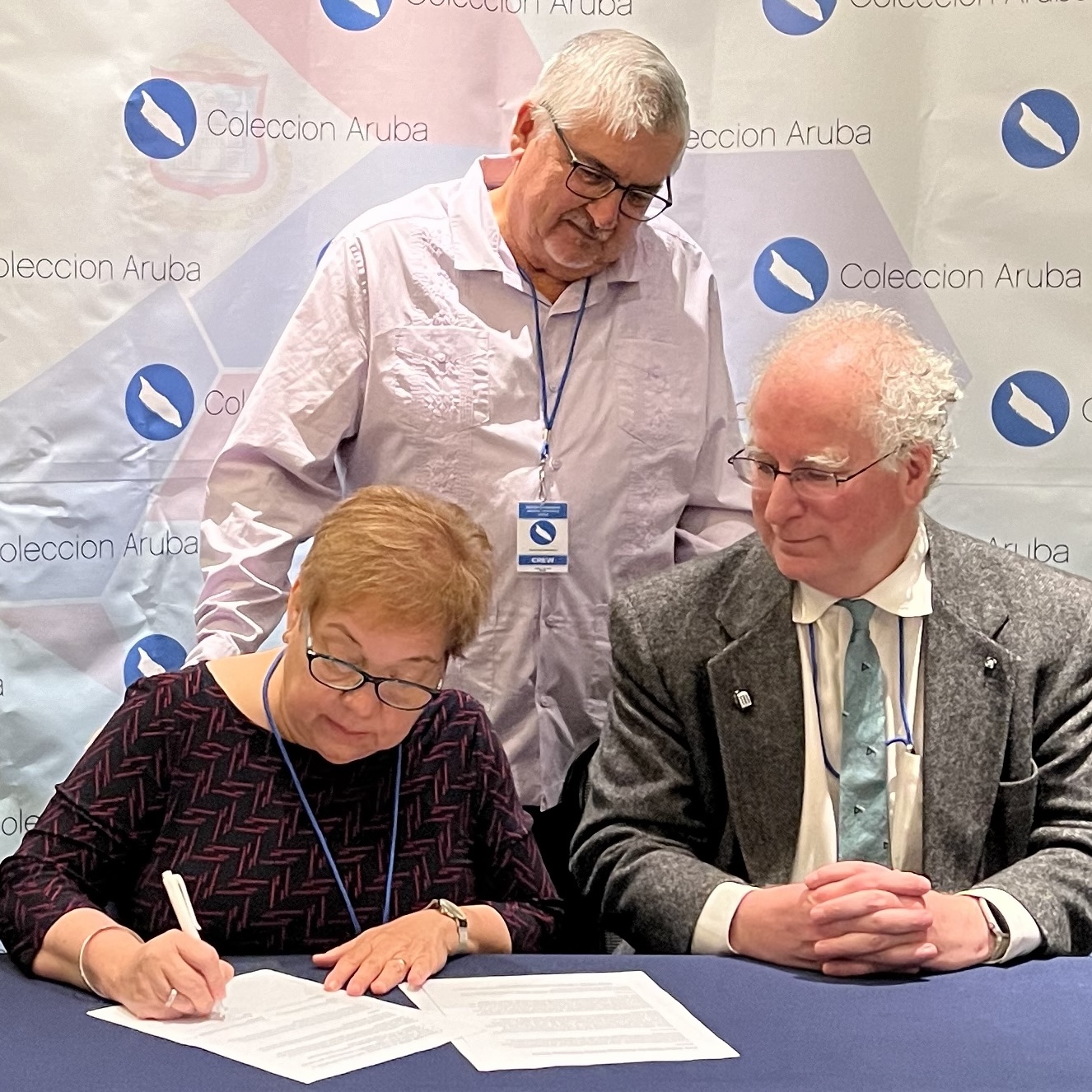
From left: Mrs. Astrid Britten, Director of the National Library Aruba; Mr. Raymond Hernandez, Director National Archives of Aruba; and Brewster Kahle, Internet Archive, at the signing of the Statement Protecting Digital Rights of Memory Institutions, April 9, 2024.

In another historic first, Aruba became the first country to officially endorse the Statement Protecting Digital Rights of Memory Institutions, recognizing the importance of libraries, archives, and museums in preserving digital cultural heritage. By supporting this statement, Aruba set a powerful precedent for nations worldwide to protect the digital rights of libraries and memory institutions. You can read more about Aruba’s leadership in this area here.

Brewster Kahle, founder of the Internet Archive, praised Aruba’s commitment to the digital preservation of cultural heritage, describing the nation’s efforts as “a beacon of hope in the global movement to safeguard history in the digital era.” In his reflections on Aruba’s leadership, Brewster wrote that “Aruba’s bold support of library digital rights shows what is possible when nations value not just their own history, but the global importance of memory institutions. Their commitment sends a strong message: culture, knowledge, and history belong to everyone.” 

What the Award Means for Aruba

Reflecting on the award, the Minister of Finance and Culture, Mrs. Xiomara Maduro remarked, “We thank Internet Archive for this great honor of recognizing Aruba’s hard work and efforts in preserving and making our cultural heritage accessible through the Coleccion Aruba online platform. This award is a significant encouragement to continue our work in safeguarding our culture and history. Thank you for supporting our efforts to keep our rich cultural heritage alive and accessible for our future generations.”

Mrs. Astrid Britten, Director of the National Library Aruba: “We are beyond excited and deeply honored by this recognition from the Internet Archive. What began in 2018 with Mr. Peter Scholing at the National Library of Aruba, and our partnership with the Internet Archive, has grown into something truly remarkable. The launch of Coleccion Aruba earlier this year marks a significant milestone in our journey, and it’s inspiring to see over 150,000 digital items—more than the number of inhabitants on our island—shared globally. The involvement of the National Archives of Aruba (under the leadership of Mr. Raymond Hernandez and Mr. Edric Croes), UNOCA (Ms. Ray-Anne Hernandez), and other key partners since 2022 has strengthened our mission to ensure that Aruba’s cultural treasures are preserved and accessible, not only for our own people but for audiences far beyond our shores. Aruba’s dedication to preserving digital history and ensuring access to knowledge for all has set a new benchmark for collaboration, through innovation and partnership. This acknowledges Aruba’s impact in digital preservation.”

Mr. Raymond Hernandez, Director National Archives of Aruba: “On behalf of Coleccion Aruba, the National Archives of Aruba is deeply honored to receive the Internet Archive Hero Award. While we were never in pursuit of any awards, this recognition is a profound encouragement for the work we have been doing to preserve and share Aruba’s rich cultural heritage. This together with all of our partners as well. As a small island in the Caribbean with limited resources, our mission to make our national archives accessible to all has been driven by the belief that open access to knowledge is essential for our community and beyond. With the support of the Internet Archive, we are inspired to continue on this path and hope to serve as a model for other small island states in development, especially in the Caribbean. This award reinforces our commitment to creating a future where information is freely accessible  to all, and we are sincerely grateful for this support.”

Fotocollectie Hochstuhl, potret # 305 (1950-1960). From Coleccion Aruba: https://archive.org/details/ANA-DIG-HOCHSTUHL-305

Mrs. Ray-anne Hernandez, Managing Director UNOCA (A funding agency that cofinances Art & Cultural Projects in Aruba): “We are incredibly honored and grateful to receive the Hero Award from the Internet Archive. This recognition celebrates not only our commitment to preserving and sharing Aruba’s rich history and cultural heritage but also the invaluable collaboration with the founding partners of Coleccion Aruba: the Library of Aruba and the National Archives of Aruba. Together, we have worked passionately to make our collective history accessible to the world, and this achievement wouldn’t have been possible without the support and contributions of our many partners, both big and small. This award inspires us to continue our work with even more dedication, striving to conserve and promote Aruba’s national heritage for future generations. We are driven by our shared passion for culture and history, and we look forward to further collaborations that will continue to enrich our community and beyond. Thank you again for this prestigious recognition.”

Join Us in Celebrating

Aruba will officially receive the 2024 Internet Archive Hero Award at the Internet Archive’s annual celebration on October 23, 2024, in San Francisco. The event, themed “Escaping the Memory Hole,” will focus on the role of libraries and archives in preserving cultural history in the face of vanishing media. We invite you to join Aruba’s representatives and the institutions behind Coleccion Aruba for this special occasion as we celebrate this remarkable achievement and the global importance of preserving knowledge. Register now for the virtual celebration.

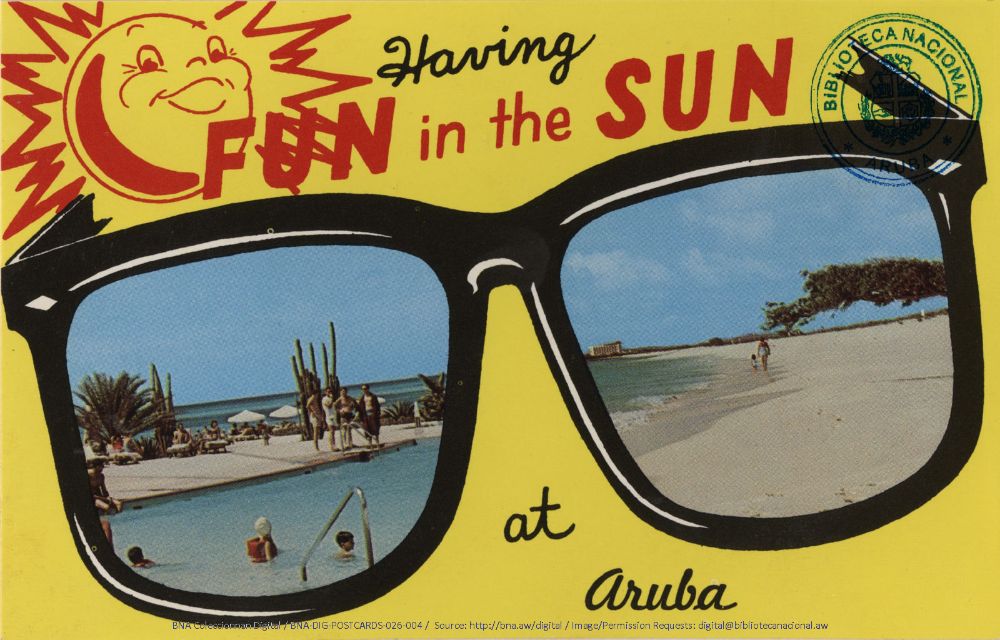
Having Fun in the Sun at Aruba (Postcard, ca. 1963) Sugar-white beaches at the Caribbean’s newest vacation playground. From Coleccion Aruba: https://archive.org/details/BNA-DIG-POSTCARDS-026-004