Tag Archives: film contest

Announcing the 2026 Public Domain Film Remix Contest Winners, Honorable Mentions & Finalists

We’re thrilled to unveil the creativity of our top three winners and four honorable mentions in this year’s Public Domain Day Film Remix Contest. These remarkable films not only reimagined and transformed public domain works but also demonstrated the boundless potential of remixing creative works to create something new.

This year’s contest received more than 270 submissions from creators across 35 U.S. states, as well as Puerto Rico and Washington, DC, and 28 countries worldwide. All of the submissions can be viewed in a new collection at the Internet Archive: 2026 Public Domain Day Film Remix Contest collection.

Our judging panel was led by Catherine Kavanaugh of Screen360.tv with jurors Peter Stein, Rick Prelinger, Amber McKinney, and Brewster Kahle.

Watch the winning entries & honorable mentions below. View the full list of finalists.


FIRST PLACE: “Rhapsody, Reimagined” by Andrea Hale

About the film: Rhapsody, Reimagined reconfigures imagery from King of Jazz (1930) through collage, digital animation, and repetition set to a reimagined version of George Gershwin’s Rhapsody in Blue.

A woman in a striped shirt and beanie drumming.
Andrea Hale

Judge’s Comment: Andrea Hale’s sharp description: “Treating image as modular rather than linear, the film foregrounds systems of synchronization, reproduction, and spectacle,” signaled to the judges that we were in for a surprise. The stripped down remix of Gershwin’s Rhapsody in Blue lifted us gently into a 1930s office scene in deco sherbert colors that deconstructed and rebuilt through a mind-blowing kaleidoscope of dancers, musicians, and other images from John Murray Anderson’s “ The King of Jazz”….finally landing us back on a moon…A fabulously fun use of archival footage – we all agreed, it was an aesthetic triumph! Congratulations to Andrea Hale

Andrea Hale is an artist working in animation and video editing. Her work emphasizes rhythm, repetition, and texture, using collage to recontextualize culturally established works by treating them as raw material rather than finished objects.


SECOND PLACE: “Battle Lines” by Jen Zhao and Aaron Sharp

About the film: The friendship and rivalry between two painters: Piet Mondrian and Theo van Doesburg.

Selected Judge’s Comment: This is a neatly made little film that used 22 archival works and doesn’t quite escape the burden of telling the story of the feud between Mondrian and van Doesburg. It’s a perfectly pitched, tongue-in-cheek short doc(mock)umentary tracking their feud over the diagonal line. Masterful editing of inspired sources including Composition II in Red, Blue And Yellow by Mondrian (1930) and Jean Cocteau’s “Le Sang Un Poet” with costumes by Coco Chanel. It’s deft narration winks at parody yet unfolds the story in a memorable cadence to its tender end and sends viewers to research further. Congratulations to Jen Zhao and Aaron Sharp

A woman smiling softly into a camera.
Jen Zhao

Jen Zhao is a Canadian filmmaker, producer, and actor who is interested in autofictional works that explore reality, genre, and the experience of making art itself. She works with an ethos of “scrappiness”, creating films with whatever resources are on hand or easily accessible, which is exemplified in her short film Finding Nathan Fielder (With Jen Zhao). Jen has released work with Penguin Random House, Spotify, and Cosmic Soup Productions, and received her MFA in Screenwriting from UCLA.

A man with glasses and a beard smiling into the camera
Aaron Sharp

Aaron Sharp is a screenwriter and actor from Los Angeles. He has an MFA from UCLA TFT and loves acronyms. He is currently working on 8 Votes, a true-crime podcast that investigates how his best friend received only eight votes in his high school presidential election, and whether foul play was involved.


THIRD PLACE: “Farina & The Perpetual Shine Machine” by Ralphie Wilson

About the film: Allen “Farina” Hoskins hosts an interrogative look into the depiction of black life during the year 1930 in this short film, unease follows.

Ralphie Wilson

Selected Judge’s Comment: This film highlights terrific sourcing and intercutting of both uplifting and disturbing depictions of African and African American film imagery from 1930. Not at all gratuitous in its presentation of images from governmental, industrial and educational archives, the familiar comic expression of Our Gang’s Farina, Allen Hoskins, softens the disquieting impact and prompts further inquiry. The Hall-Johnson Choir’s spiritual directed by Broadway performer Juanita Hall (later known for “South Pacific”) elevated imagery and soundscore, further highlighting the conundrum in our fraught history. As director Ralphie Wilson stated in his description, “Unease follows.” Thank you and congratulations, Ralphie Wilson

Ralphie Wilson is a street photographer, editor and independent filmmaker from St. Louis, MO. He has a love for archive work and capturing The Black Experience throughout all mediums.


HONORABLE MENTION: “The Boots on the Western Front” by Thomas Biamonte

Thomas Biamonte

About the film: An anti-war short film that showcases the horror of modern warfare and its toll on the human psyche as seen in the 1930 Best Picture winner at the 3rd annual Academy Awards All Quiet on the Western Front. The film is paired with a 1915 reading of Rudyard Kipling’s 1903 Anti-War poem Boots.

Thomas Biamonte is currently an undergraduate student at the University of Hartford studying acting. He is a huge fan of the public domain and the internet archive and he is honored to be chosen as an Honorable Mention.


HONORABLE MENTION: “How’s the Play Going?” by Noel David Taylor

Noel David Taylor

About the film: An absurd comedy with the main character lost in time, disjointed in settings and confused by their surroundings. Sort of like that thing that happens when you realize you haven’t been paying attention to the film you’re watching.

Noel David Taylor is a filmmaker known for their alchemy of homemade nightmare comedy and an absurdist sense of tragedy.


HONORABLE MENTION: “Dream A Little Dream Of Me Reimagined” by Talissa Mehringer

About the film: A new short music-film remix celebrating the dynamism of 30s film choreography, the opulence of the sets, and the versatile talent of the featured stars.

Talissa Mehringer is a German/Mexican multimedia artist and filmmaker residing in Berlin. Her work springs from a desire to bring to life dreams and experiences filtered through the subconscious.


HONORABLE MENTION: “The Reality Engineer” by Konstantin

About the film: A comedy film that tells the story of a scientist who wants to help humanity live better by correcting reality itself. However, every good intention only makes the situation worse.


ALL FINALISTS (ALPHABETICAL BY TITLE)

2026 Public Domain Film Remix Contest: The Internet Archive is Looking For Creative Short Films Made By You!

Poster for the Internet Archive’s 2026 Public Domain Film Remix Contest, featuring the “Lockette,” a cartoon character with an open lock, seated in a director’s chair, legs crossed, and holding a megaphone. Projected on a screen to her right is a frame from the 1930 film “King of Jazz”. Illustrated by Freya Morgan.

UPDATE January 21, 2026: Contest winners have been announced. Congratulations to the winners, honorable mentions & finalists, and special thanks to everyone who submitted a film this year!

We invite filmmakers, artists, and creatives of all skill levels and backgrounds to celebrate Public Domain Day, by creating and uploading a 2-3 minute short film to the Internet Archive.

This contest offers a chance to explore and reimagine the creative treasures entering the public domain, especially works from 1930 that entered the public domain on January 1—classic literature, early sound films, cartoons, music, and art. Participants are encouraged to use materials from the Internet Archive’s collections to craft unique films that breathe new life into these cultural gems. Browse newly opened public domain materials.

Top entries will be awarded prizes up to $1,500, with winners announced during our virtual and in-person Public Domain Day Celebrations on January 21, 2026. All submissions will be featured in a special Public Domain Day Collection on archive.org and highlighted in a January 2026 blog post.

Join us in this creative celebration of cultural heritage and timeless art!

Guidelines

  • Make a 2–3 minute movie using at least one work published in 1930 that will become Public Domain on January 1, 2026. This could be a poem, book, film, musical composition, painting, photograph or any other work that will become Public Domain next year. The more different PD materials you use, the better!
    • Note: If you have a resource from 1930 that is not available on archive.org, you may upload it and then use it in your submission. (Here is how to do that). 
  • Your submission must have a soundtrack. It can be your own voiceover or performance of a public domain musical composition, or you may use public domain or CC0 sound recordings from sources like Openverse and the Free Music Archive.
    • Note: Sound recordings have special status under Copyright Law, so it’s important to note that while musical compositions from 1930 will be entering the public domain, the sound recordings of those works are not. Sound recordings published in 1925 will enter the public domain. 
  • Mix and Mash content however you like, but note that ALL of your sources must be from the public domain. They do not all have to be from 1930. Remember, U.S. government works are public domain no matter when they are published. So feel free to use those NASA images! You may include your own original work if you put a CC0 license on it.
  • We are celebrating the public domain as a triumph of human creativity, and we want your submission to reflect that spirit. The contest honors the imagination, craft, and originality that people bring to remixing culture, so your final film should be a human-made work of art. If you use AI tools in your submission, please explain how they are used.
  • Add a personal touch, make it yours!
  • Keep the videos light hearted and fun! (It is a celebration after all!)

Submission Deadline

All submissions must be in by 11:59pm PST, January 7, 2026.

How to Submit

  1. Create an Internet Archive account.
  2. Upload your film to archive.org.
    • Add a subject tag field of “remix contest 2026” in the upload form.
    • Link all your sourced materials from 1930 or prior in the upload description.
    • Copy the URL/link to your submission, you will need it for the submission form.
  3. Complete the online Submission Form.

To help get you started here are some materials that will become part of the public domain on January 1, 2026. See examples.

  • Books: The first four original editions of the Nancy Drew books, including The Secret of the Old Clock. As I Lay Dying by William Faulkner. Dick and Jane made their first appearance in the Elson Basic Readers. The Little Engine That Could by Watty Piper choo-chooed onto the scene.
  • Comics: The iconic Blondie by Chic Young first debuted in 1930. Mickey Mouse made his first appearance in comics in 1930 featuring multiple serialized storylines! Even more Popeye stories including those featuring the Sea Hag!
  • Films: The King of Jazz, a two-strip Technicolor musical revue featuring Bing Crosby, elaborate sets, and Vaudevillian routines. Morocco, a melodrama featuring Marlene Dietriech pushing the boundaries of pre-Hays Code Hollywood. All Quiet on the Western Front, the Best Picture winning adaptation of the novel. Dizzy Dishes, the first appearance of Betty Boop in film. The Picnic, a Disney short featuring the debut of Rover, the dog that would become Pluto a year later.
  • Musical Compositions: It Happened in Monterey, a song of longing for romance past. But Not for Me, a lament about love songs. Livin’ in the Sunlight, Lovin’ in the Moonlight, a carefree celebration. Dream A Little Dream of Me, a wishful request of longing. Beyond the Blue Horizon, a song that invokes our own blinking servers that made 1 trillion webpages possible. Georgia on My Mind, a song that became the official state song of Georgia in 1979. You can record your own versions of any of these compositions and reuse them in your film.
  • Sound Recordings (1925): A Cup Of Coffee, A Sandwich & You, a fox trot rendition by the Carleton Terrace Orchestra. St. Louis Blues by Bessie Smith ft. Louis Armstrong on the cornet. I’ll See You in My Dreams by the Isham Jones Orchestra, the top selling record of 1925. Manhattan by Ben Selvin Orchestra as The Knickerbockers, a jazzy evocation of the city.

Prizes

  • 1st prize: $1500
  • 2nd prize: $1000
  • 3rd prize: $500

Judges will be looking for videos that are fun, interesting and use public domain materials, especially those from 1930. Submissions should highlight the value of having cultural materials that can be reused, remixed, and re-contextualized for a new day. Winners will be announced and previewed at our virtual event, then shown on the “big screen” and celebrated in person at the in-person Public Domain Day party in San Francisco. Winners’ pieces will be purchased with the prize money, and viewable on the Internet Archive under a Creative Commons license.

Past Winning Submission Examples

  • The Situationship
    • A thoughtful edit that condenses a whole film down to short film length while also updating its context for the present day with a Sapphic love story.
  • When I Leave the World Behind
    • Queline Meadows’s inspired mix of movies, images, music and text woven into a subtle and emotionally affecting video expressing a strong sense of nostalgia and the irretrievable passage of time.
  • Just Like A Hollywood Star
    • A rich montage of sound and picture, focusing on images that model beauty, fitness, posture, proper behavior, and the laws of physics to produce an unpredictable result.
  • 1928 Playable Demo
    • An inventive creation positioning old film as a video game invoking feelings of interactivity.
  • This Is The Science Of Optics
    • A collage of sight and sound with experimental elements bending the visuals and leaving the audience with pontifications about existence.
  • Danse des Aliénés
    • This trippy piece creates a visual experience unlike others with animation, bold colors, and unique framing to draw the viewer in and invoke experimental filmmaking of later decades with older materials.

For further reference, check out past entrants from 2025.

Announcing the 2025 Public Domain Day Film Remix Contest Winners & Honorable Mentions

We’re thrilled to unveil the creativity of our top three winners and three honorable mentions in this year’s Public Domain Day Film Remix Contest. These remarkable films not only reimagined and transformed public domain works but also demonstrated the boundless potential of remixing creative works to create something new.

Watch the winning entries & honorable mentions below. Renowned film archivist Rick Prelinger returned to lead the jury, comprised of film professionals and enthusiasts including Simone Elias, Lara Gabrielle, BZ Petroff, and Theo Unkrich, offering insightful commentary on each selection and its standout qualities.

Explore all 140+ submissions at the 2025 Public Domain Day Film Remix Contest collection at the Internet Archive.


First Place: “When I Leave the World Behind” by Queline Meadows

https://archive.org/details/when_i_leave_the_world_behind_remix

From Rick: The jury was deeply impressed by Queline Meadows’s inspired mix of movies, images, music and text woven into a subtle and emotionally affecting video expressing a strong sense of nostalgia and the irretrievable passage of time.


Second Place: “The Archive Boogie” by Samantha Close

https://archive.org/details/the-archive-boogie

1929 was a great year for the movies! Filmmaker Samantha Close expresses both the breadth of 1929’s production and the eternal bounty of the public domain, using images from 1929’s films and public domain images from elsewhere and elsewhen.

Learn more about Close & the film in this interview.


Third Place: “THE SITUATIONSHIP” by Samara Meyer

https://archive.org/details/the-situationship

Meyer’s crowdpleasing film features the daring, dazzling “It Girl,” Clara Bow, who lights up the screen in more ways than one in this Sapphic love story.


Honorable Mention – History: “Moving Pictures Aren’t What They Used to Be” by Jeremy Floyd

https://archive.org/details/moving-pictures-arent-what-they-used-to-be

Jeremy Floyd’s enjoyable piece pays tribute to an uninhibited period of filmmaking — Hollywood before the passage of the restrictive Production Code, when movies were filled with roguish suggestion and undisguised violence.


Honorable Mention – Home Movies: “Hoffman’s Honeymoon” by William Webb

https://archive.org/details/hoffmanns-honeymoon-1

Of all film genres, home movies are the most numerous yet the least seen and known. Webb’s engaging video brings them into the foreground, adding voices from dramatic films in the public domain, to build a goofy but endearing narrative.


Honorable Mention – Live Action: “The Wayback Machine” by DIEGO DIAZ & CAN SARK

https://archive.org/details/wayback-machine-4k

Diaz and Sark’s film is an audacious and yes, dopey exploration of the essential greatness of Internet Archive and the dread near-infinity of copyright.

Public Domain Day Celebrates Creative Works from 1928

Hundreds of people from all over the world gathered together on January 25 to honor the thousands of movies, plays, books, poems and songs that recently entered the U.S. public domain.

Steamboat Willie, Walt Disney’s 1928 animated film featuring Mickey Mouse, had top billing at the virtual event. Literature now free from restriction for reuse includes Orlando by Virginia Woolf and Tarzan Lord of the Jungle by Edgar R. Burroughs. Sound recordings from 1923 (released on a different schedule) joined the public domain such as ”Down Hearted Blues” by Bessie Smith and ”Who’s Sorry Now” by Isham Jones Orchestra.

WATCH RECORDING:

“There’s so much to rediscover and to celebrate,” said Jennifer Jenkins, director of the Center for the Study of the Public Domain at Duke Law School. For example, the release of The Great Gatsby into the public domain in 2021 inspired a creative flurry — new versions of the novel from the perspective of different characters, a prequel telling the backstory of Nick Caraway, a young adult remix, and song. “From the serious to the creative, to the whimsical to the wacky, these are all the great things we can do…now that [these works] are in the public domain and free to copy, to share, to digitize and to build upon without permission or fee.”
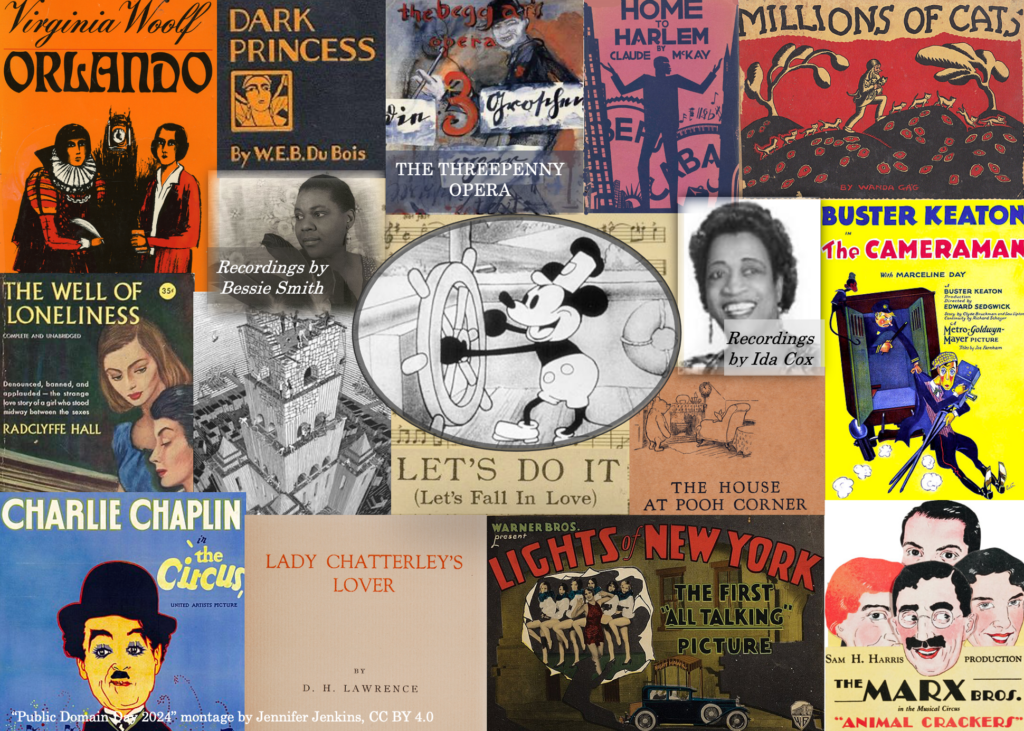
For an overview of new works in the public domain, view the curated list from the Center for the Public Domain.

Remix Contest

The winning film from the Public Domain Day 2024 Remix Contest was shown as well: “Sick on New Year’s,” by Ty Cummings. Every year since 2021, this contest has invited artists to remix works from its collection to showcase new and creative uses of public domain materials. Fifty films were submitted to this year’s competition, according to Amir Esfahania, artist in residence at the Archive. Learn more about the finalists or watch all the submissions in our recent blog post.

Advocacy

“Celebrating the public domain is not just about vintage references and period-appropriate clothing. It’s about understanding history to inform the present day,” said Lila Bailey, Internet Archive senior policy counsel and co-host of the virtual festivities. “We think there should be time set aside every year to celebrate the immense riches that free and open culture provides to everyone.”

While federal holiday recognition (like MLK Day or Presidents’ Day) for the public domain is unlikely, there was a discussion of an advocacy campaign for establishment of a commemorative Public Domain Day (more along the lines of National Data Privacy  Day or National Whistleblowers Day).

“It only requires a simple resolution in the Senate with high chances of recognition,” said Amanda Levendowski, director of Georgetown Law School’s Intellectual Property and Information Policy Clinic. “Prospects for passage are way better than possible. About 80 percent of proposals are passed — and maybe next year, Public Domain Day will be among them.”

Experts said a successful drive for the designation will require a collaborative effort. A kickoff event will be held February 29 in New York City, hosted by Library Futures, executive director Jennie-Rose Halperin announced.

AI and the Public Domain

The online program also featured a panel discussion on generative artificial intelligence, copyright and artist expression. Experts weighed in on just what should be the copyright status of the outputs of generative AI.
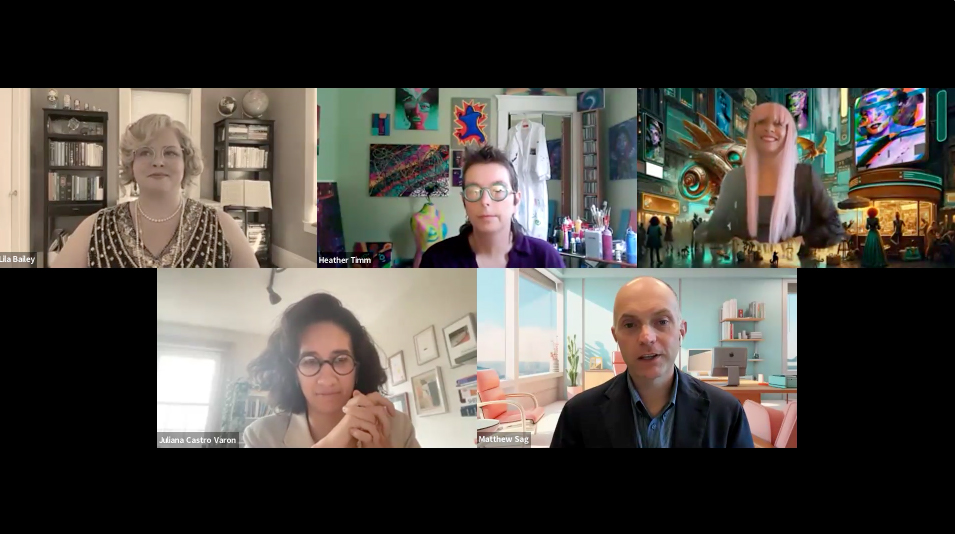
Panelists (clockwise from top left): Lila Bailey (Internet Archive), Heather Timm (artist), Maxximillian (artist), Matthew Sag (Emory Law), and Juliana Castro Varón (Cita Press).

Now, AI tools can turn text or simple descriptions into images that are  genuinely new and often look like exactly the kind of things that people get copyrighted if a human made them, explained Matthew Sag, professor of law, artificial intelligence, machine learning, and data science at Emory University.

“The copyright office is quite clear that to get copyright, you have to have human authorship. So something created entirely by an unsupervised machine is not eligible for copyright,” Sag said, noting that the courts have recently agreed. “The interesting question is what about when humans are using AI as a tool and directing the output. This is where the controversy really is.”

On the panel, two artists, Heather Timm and Maxximillian, shared how they both leverage AI in the creative process.

Timm said she started using generative AI in 2021 and thinks the copyright office should cover works that have results from it. She has trained AI models on her own physical work and then created something new collaborating with the machine, as well as conceptualized how to blend different pieces of work in a collage or sculpture.  

“I use it almost as a notebook,” Timm said. “If I have a concept or an idea about something on the go, I can immediately prompt that and have it as a placeholder to explore it later.”

As a filmmaker and musician, Maxximillian said she feels passionate about AI and it has saved her time creating animated characters and helping refine her text. “As a professional artist, I rely on copyright to keep viable the works that I produce for clients legally,” said Maxximillian. “It’s important to understand that copyright protection enables the creator to be a steward of that work. The question to consider: Who benefits by denying copyright on AI? I think nobody benefits.”

An open access publisher, Juliana Castro Varón, design director and founder of Cita Press, also addressed the issue. “I believe that AI may pose economic, power, and labor challenges, but I feel very confident that creativity will survive technology,” she said. All books Cita produces are in the public domain for everyone to download. “We are not at all against people using AI for their work, but we continue to hire humans…elevating the work of people is core to our mission.”

***

The event was co-hosted by Internet Archive and Library Futures with support from Creative Commons, Authors Alliance, Public Knowledge, SPARC and Duke Law’s Center for the Study of the Public Domain.

Lights, Camera, Victory! Public Domain Day 2024 Remix Contest Winners Revealed

After sifting through a sea of talent and creativity, we are thrilled to present the cinematic achievements of three winners and two honorable mentions in our Public Domain Day 2024 Remix Contest. These winning entries not only captivated our imaginations, but also showcased the immense power of remixing, reimagining, and breathing new life into public domain works.

View the winning entries & honorable mentions below. Rick Prelinger, noted film archivist, helped judge the competition and offers why each film was selected for recognition.

Browse all submissions (52!) at the Public Domain Day Remix Contest collection at the Internet Archive.

First Place: “Sick on New Year’s” by Ty Cummings

Found-footage filmmaking is all about taking material that might have almost-sacred status and, well, bringing it back down to earth. We find this film worthy of our first prize because of its irreverent humor and skilled editing, its playful predictions of the future, and because it points to the limitless opportunities that a constantly-refreshed public domain offers makers in all media.

Second Place: “Keaton and Kaufman: The Cameramen” by Max Teeth

This film brings together two characters who will be familiar to people who love films, characters that lived and worked very far away from one another and did deeply different work, but might perhaps have more in common with one another than we might think. We see it as a poetic piece, a loving tribute to some of the people who put the motion in motion pictures.

Third Place: “Just Like a Hollywood Star” by Timothy Johnson

Our 3rd prize winner is a rich montage of sound and picture, focusing on images that model beauty, fitness, posture, proper behavior, and the laws of physics. We like this film’s uninhibited reach and its draw from wildly disparate material, often pretty predictable, to produce an unpredictable result.

Honorable Mention, Historical Perspective: “A Member of the Family” by Lizzy Tolentino

Combining government-produced films, family home movies and an unusual sponsored film by a world-famous company, this filmmaker makes a chilling statement about the gap between the promise of our society and the reality of 20th-century history. The public domain is a record of both proud achievements and disturbing histories, and we feel this film exemplified the potential of the public domain to reveal histories that some might prefer to be kept silent.

Honorable Mention, Quirkiest Film: “Domain” by Cullen J. Sanchez

Sometimes you just have to recognize the unusual. But this unusual film makes a critical point about the public domain — that WE are the public domain, and the public domain is us. Take it away! “It’s us. It’s all of us.”