Category Archives: Upcoming Event

Introducing the DWeb Camp 2026 Venue: Alte Hölle

As our group of DWeb Camp organizers arrived at Wiesenburg station, frazzled by countless train delays in Berlin, a light rain and a blossoming gray winter sky welcomed us.

Moments after our arrival, a car and a van swooped up in front of us. Two of Alte Hölle’s stewards, Marv and Störte, had come to pick us up. During our days at this former forest hotel, we heard a common refrain: Imagine this place greener and warmer. Still, we did not have to stretch our imaginations very far. From the very first moment we laid eyes on Alte Hölle e.V., the only thing we could see was DWeb Camp 2026.

“We are just starting to wake up,” Marv told us while we looked across the property in late February. Just a couple of weeks earlier, snow levels reached an almost record 71 cm, and temperatures sank to double digits below zero. We arrived at this Brandenburg event space as bare trees, families of wild boars, and humans alike were emerging from their winter hibernation.

A photo of the main building of Alte Hölle during our Winter visit

Alte Hölle has a very special history. Originally built in the 1800s as a Prussian forestry administration center, it later became a recreational facility for the Secret Service of communist Eastern Germany. Then a woman purchased it in the 1990s and managed it for three decades as a forest getaway spot. By 2021, the hotel wasn’t making a profit and she was searching for successors to take over. The full potential of this historic venue was yet to be recognized and realized.

A photo of Alte Hölle during the summer
The pool of Alte Hölle at night

At the same time, a diverse ensemble of friends who met at Chaos Communication Congress got together, looking for a place to establish a physical base to gather, build and host events and festivals. The old forest hotel was finally seen by the right sets of eyes, imagining it in a new light!

The façade of the hotel at night, lit by coloured lights

These ardent builders and dreamers booked the whole hotel for a week, coming up with ideas and ways to infuse the space with new life. After witnessing their process, the original owner slowly decided that selling her life’s work to a loose group of DIY enthusiasts was really the best option.

In 2021, this group purchased Alte Hölle, transferring the property to an association to ensure its long-term stability as individual involvement shifts and changes. Ownership by an association establishes Alte Hölle as a collectively-run physical commons. The members of the collective chipped in smaller amounts to secure a long term loan, thus collectivizing and decentralizing ownership and financial risk.

Rural Brandenburg isn’t exactly a cultural hotspot attracting scores of young people. Yet, for the Alte Hölle collective this place offers an opportunity to usher in change and a new cultural presence in the Brandenburg area. We don’t want to be a group of happy dropouts isolated from society, Störte explained to us. Our intention is to look outward, participating in local initiatives, bringing people to this place, and being a backbone for community organising and democratic practice.

The Alte Hölle collective welcomes open involvement in decision-making and shaping the future of the project. Alte Hölle’s governance model is non-hierarchical and based on consensus. It’s hard to distinguish between who lives there and who doesn’t: people come and go, but they still actively contribute to decision-making and developing Alte Hölle’s infrastructure. We want to blur the lines as much as possible between who is here and who is not, because not everyone can afford to work remotely and stay long term, but this should not influence their sense of belonging to the project, says Franzi, one of the stewards of the venue.

Alte Hölle runs as a seminar hotel for a broad variety of groups. Other collectives come there to organize retreats, literary groups hold reading events on the grounds, bike enthusiasts come for week-long workshops. And from July 8-12 2026, Alte Hölle is welcoming DWeb Camp.

How did we select this unique place an hour southwest of Berlin? It becomes clear if you look back at the history of Camp and the principles that guide our decisions.

Since our first outdoor convening, we’ve aspired to work closely with our venue’s stewards to help improve the land. We did so at the Mushroom Farm in 2019, when we brought stable internet to the remote California coastal location by building a tower and installing antennas across the property to establish a local mesh network. We want DWeb Camp to be firmly grounded in a place. A place with history, community, strong values, and aspirations. A place that shares our principles of giving agency to people, distributing value and power broadly. DWeb seeks to achieve this in the digital realm; Alte Hölle does so in a collectively-run 100,000 square meters of forest and field.

In November, we sent an email to share our ideas and explore the possibility of hosting Camp at Alte Hölle. Marv was the first to see our inquiry. As I read that email, a few things immediately just clicked. The right values, talks and workshops with interesting content and initiatives. I sent a very enthusiastic reply, and a couple of weeks later we were walking the place together with a first exploratory delegation from DWeb.

Then in February, a dozen members of our team convened to survey the site and start planning the details.

Marv of Alte Holle pointing out power, connectivity, and other features of the 100,000 square meters of the property.

So now, the organizing machine is in full motion. We are meeting the vibrant culture of Alte Hölle with the joyful spirit of DWeb Camp. Not only will we have a lot of infrastructure to build, but also many things to make! Using wood sourced from local forests, we plan to craft benches, tables, and some other key structures we’ll need at camp.

The DWeb and Department of Decentralization organizers and the Alte Hölle community are looking forward to welcoming you to this land of rich history and abundant promise.

As Franzi shared, I love the idea and the principles behind DWeb Camp, and I am really looking forward to having an international event with many people coming from all around the world!

A music festival at Alte Hölle
Sunrays and people walking on the Alte Hölle field.

How DWeb Camp is Being Built in Berlin

At the legendary c-base, technologists, activists, and artists gathered to shape the next chapter of the decentralized web.

c-base is a space station that “crashed” and is being reconstructed along the Spree river by a group of Berlin hackers. Some call it the mother of all hackerspaces.

On a gray February morning in Berlin, people wandered down a dark ramp into a space station.

Not a metaphorical one—at least not entirely. c-base, with its blinking lights, maze of cables, and decades of hacker lore, has long described itself as a space station that crashed on Earth 4.5 billion years ago. Since the mid-1990s it has been a gathering place for coders and tinkerers who prefer to build the future themselves rather than wait for it to arrive.

On this particular morning, they had come to design something new.

In February, an invitation had circulated across Europe’s decentralized technology networks: come to c-base and help shape the next DWeb Camp, a five-day gathering that will take place this July in the forests of Brandenburg.

There was no fixed agenda, and no finished plan.

Just a question.

If we were to build the next version of DWeb Camp together, what might it look like?

Before long, the room filled. Peer-to-peer developers had come from Edinburgh, free-software advocates from Berlin, privacy-first technologists from Shanghai, and policy thinkers from Copenhagen. Artists, funders, open-source builders, and organizers filtered in carrying laptops and winter coats. Most of them had never met before.

They had come not just to attend—but to help build something.

The timing was not accidental. Across the world, the systems shaping the internet—and increasingly public life—are consolidating. Governments tighten control. Platforms encroach on our privacy. The internet as we know it is splintering, and along with it, our consensus about what is true. For many in the room that morning, the pressing question was can we restructure the web before it hardens into something more destructive than its early architects ever imagined?

DWeb Camp, first held in Northern California in 2019, grew out of that concern. The gathering was conceived as a place where technologists, artists, organizers, and policymakers might come together to begin building a more decentralized web.

A web built less like a pyramid and more like a forest. Distributed. Resilient. Sharing resources underground.

This summer, DWeb Camp’s theme is “Root Systems,” and it moves to Europe for the first time. The meeting at c-base was an early step in imagining what might grow there.

For an hour, Internet Archive founder Brewster Kahle answered the questions of DWeb Sr. Organizer, Wendy Hanamura, in a wide-ranging chat about public AI, his successes and failures, and the imperative for decentralization in this political moment.

Origins of a Decentralized Gathering

“It feels like I’m coming home,” Brewster Kahle, founder of the Internet Archive, said when he opened the morning.

Kahle traces some of the inspiration for DWeb Camp to the Chaos Communication Camp, the sprawling hacker gathering he first attended in 2003. But his vision was always more focused: an event where technologists could work alongside artists, organizers, and policymakers to imagine and build the infrastructure of a decentralized web.

“A web that’s more private, more reliable, but still fun,” he said, hopping up and down. “A web with many winners.”

Collective Intelligence

“It feels like I’m coming home,” Brewster Kahle, founder of the Internet Archive, said when he opened the morning.

Kahle traces some of the inspiration for DWeb Camp to the Chaos Communication Camp, the sprawling hacker gathering he first attended in 2003. But his vision was always more focused: an event where technologists could work alongside artists, organizers, and policymakers to imagine and build the infrastructure of a decentralized web.

“A web that’s more private, more reliable, but still fun,” he said, hopping up and down. “A web with many winners.”

Collective Intelligence

At c-base, Kahle and a dozen core organizers didn’t arrive with a finished program. Instead they facilitated breakout conversations, solicited unconference topics, and most importantly, listened.

Throughout the day, small circles formed across the space station, and similar themes surfaced again and again.

Not everything, participants suggested, needs to scale to billions of users. Perhaps some of the most important decentralized tools will serve smaller networks—families, communities, groups of collaborators who know one another. An intimate web, as some people called it, rather than the global one.

Others spoke about shared infrastructure in a broader sense: not just software, but the resources communities could distribute. Buildings. Time. Convenings. Knowledge. The question, several people suggested, was not simply how to build better tools but how to sustain the ecosystems that allow those tools to exist.

Hölke Brammer, of the Hypercerts Foundation, offered a framework that drew nods around the table.

“It’s said, first you need the values,” he recited.
“Then governance.
Then the right incentives.
And finally the technology to build it.”

DWeb Camp tries to bring all of those layers together in the same place at the same time. Which means inviting not just engineers but researchers, economists and storytellers.

Marek Tuszynski, co-founder of Tactical Tech, offered a wry observation about how the technology world often divides itself.

“They say technology is inspired in San Francisco,” he recounted. “It’s built in China. And criticized in Europe.”

The challenge, he suggested, was to move beyond those boxes—to collaborate across them.

Later, when participants were asked what would make the camp most valuable, one answer surfaced repeatedly.

“To find the people I want to work with after Camp,” someone said, “and figure out how to keep working together on an on-going basis.”

Grounded in Place

Franzi and Marv, two of the stewards of the Alte Holle Collective, share the terrain of the 100,000 sq. meters retreat site.

DWeb Camp has always been shaped by the places where it occurs.

When organizers began looking for a European site, they eventually settled on Alte Hölle, a forested property in Brandenburg about an hour southwest of Berlin.

The decision had as much to do with the people stewarding the land as with the landscape itself.

In 2021, a collective of friends who met at Chaos Communications Camp purchased the property—once a Stasi recreation site—with the intention of turning it into a long-term gathering place for artists, hackers, and activists.

Their question was straightforward.

Why build a camp only to dismantle it a few days later?   Why not create infrastructure that could remain?

Two of the site’s stewards, Franzi and Marv, joined the gathering at c-base. Rather than simply presenting the site, they participated in the discussions, listening carefully to the people who will soon gather there.

“We share a lot of the same values,” they said. “We are a volunteer group that supports [you] and is an ally for [your] event.” 

The goal, for DWeb organizers, is not merely to occupy Alte Hölle but to contribute to it—to plant something, rather than simply passing through.

The field where some 700+ campers will pitch their tents in Brandenburg.

Partners with Principles

Afri of Department of Decentralization demonstrates the programmable badge his team is developing for DWeb Camp. Via radio waves, you will be able to talk person to person at Camp, without going to the cloud or WIFI.

Strong collaborators don’t just support your vision. They push you to live up to it.

Berlin’s Department of Decentralization (DoD)—a collective formed after organizing ETHBerlin in 2018—has encouraged DWeb Camp organizers to align our tools more closely with our principles. That means prioritizing open-source infrastructure wherever possible.

Tickets will be sold through PreTix.
The schedule will run on PreTalx.
Collaborative documents will live on CryptPad.
Camp communications will be via Matrix.

Tools designed with privacy and security in mind. Not just talking about decentralization, but practicing it.

Building Across Borders

Some of the organizers of DWeb Camp from Alte Hölle, Department of Decentralization and the Internet Archive came together at c-base in February to plan for July.

Based across North America and Europe, the organizers of DWeb Camp 2026 have lineages that span the globe—Nigeria, Russia, Germany, France, Italy, Ukraine, Canada, Japan, and the United States. We come from different political contexts. Different assumptions about technology. Different cultural norms. The challenge–and the promise–is to weave those perspectives into something coherent, yet distinct. 

Toward the end of the day at c-base, Kahle returned to a theme that was disarmingly simple.

Welcome.

“This is a really special community…they welcomed me twenty years ago,” he said. “You may not be aware of the effect you have by saying ‘welcome’ to somebody from a foreign place. I think it is a hallmark of a community that is living and thriving.”

That small gesture, he suggested, can shape the direction of entire communities. “I hope that DWeb Camp is to your liking, if it’s not, say so, and let’s basically make it better. Let’s build something together.” 

Because DWeb Camp has never been a finished product.

It is something closer to a living system. It’s shaped by the people who show up, the relationships they form, and the ideas that take hold.

And in the forests of Brandenburg this July, those connections—technical, social, and human—will begin to spread beneath the surface.

Like any root system, their real strength may lie in what we cannot see.

View the fireside chat with Brewster Kahle and Wendy Hanamura.

Join Internet Archive and Partners for the National Summit on Local News Preservation

Join Internet Archive, Investigative Reporters and Editors (IRE), and the Poynter Institute for the National Summit on Local News Preservation. This event will bring together the producers, preservers, and users of local news to develop collaborative, scalable solutions to address the urgent preservation challenges presented by the rapidly changing local news landscape. 

This free, in-person event will be held on June 17, 2026 in conjunction with the IRE 2026 Conference in National Harbor, Maryland just outside of Washington, DC. 

Through panels, presentations, and facilitated discussions, Summit attendees will:

  • Discover proven strategies and partnerships behind successful local news preservation initiatives
  • Shape recommendations for local news preservation to be distributed nationally to newsrooms and memory institutions
  • Network with leaders from news and cultural heritage organizations
  • Explore tools and programs that can support the preservation and access of local digital news assets

Learn more and register to attend

This event is part of Today’s News for Tomorrow, a program supported by Press Forward. Additional support for the Summit has been provided by the Society of American Archivists Foundation. 

Coming to DWeb Camp? Archive a Memento at the Migration Station

We have a new pop-up space at DWeb Camp this year: the Migration Station, a space for archiving migration mementos and self-organized workshops. The exact location is TBD, but it will be located near the Library and rock climbing station.

Planned layout of the Migration Station

Our theme of this year’s Camp is Migration: Moving Together — to touch upon what is a pertinent reality for so many worldwide, and relate their experience to the DWeb. Beyond a poetic metaphor for moving people from the centralized web to the decentralized web, we’d like to acknowledge how masses of people are displaced due to war, genocide, climate change, and other reasons, for the sake of survival. We want to reflect on how network technology can address their needs amidst catastrophe.

And along this theme, we’re inviting all Campers to bring a small memento (up to 5×5 inches/120×120 mm) to reflect on their own personal, or resonant, migration stories. At the Migration Station, you will be able to photograph the item, write a note, and record an audio story using the Custodisco and Audiovisco kiosks.

Photo of the Custodisco Kiosk, where you can photograph and add your migration story to the digital memento archive.

Over the course of the week, you will have an opportunity to add your objects and stories. After Camp, we will take this archive, as well as a carefully selected set of small objects folks are willing to part with, and create both a digital and physical time capsule to be buried for 24 years and unearthed in 2048. The physical time capsule will be buried at the Internet Archive. The digital time capsule will be preserved using a variety of different DWeb tools and protocols in order to practically test different approaches for cultural preservation.

The exact location where we’re planning on burying the physical time capsule, at the Internet Archive garden.

Memento Ideas

Possible mementos include: A copy of family photo or historical document; a shawl, scarf or other textiles that was worn or used to carry objects; hand made art, small statues, talismans or other religious artifacts; an interesting rock from a special place; jewelry, baskets, bags, or even an old key and the story of what it once unlocked.

If you’re unable to bring a memento, you can always visit the Art Barn to create something at Camp.

A very limited number of objects will fit into the time capsule, so if you’d like your object to be considered for inclusion, please bring a memento that is no larger than a CD and is robust enough to survive for 24 years underground (i.e. no low quality paper or organic material). If your object is larger than a CD, or you don’t want to part with your object for sentimental reasons, you will still have the opportunity to create an entry in the digital archive recording your object and its story.

Above is a photo of DWeb Camp’s Executive Producer, Wendy Hanamura’s grandmother and grandfather. Wendy will be archiving the story of how both of her grandmothers came to the United States as picture brides through Angel Island in California.  

Migration Station Workshops

Throughout the week, the space will also offer self-organizing workshops, including:

  • Collective story sharing/listening
  • Archive exploration sessions
  • Discussions on archiving experiences
  • Map drawing workshops
  • Working with the archival material (ex. noise cleaning, translations)
  • Reviewing favorite archived materials
  • Discussions on the future significance of the archive

We hope you bring your mementos, stories, and dreams.

See you at the Migration Station.

Book Talk: Attack from Within by Barbara McQuade

Join us for a VIRTUAL book talk with legal scholar BARBARA McQUADE on her New York Times bestseller, ATTACK FROM WITHIN, about disinformation’s impact on democracy. NYU professor and author CHARLTON McILWAIN will facilitate our discussion.

REGISTER NOW

“A comprehensive guide to the dynamics of disinformation and a necessary call to the ethical commitment to truth that all democracies require.”

Timothy Snyder, author of the New York Times bestseller On Tyranny

American society is more polarized than ever before. We are strategically being pushed apart by disinformation—the deliberate spreading of lies disguised as truth—and it comes at us from all sides: opportunists on the far right, Russian misinformed social media influencers, among others. It’s endangering our democracy and causing havoc in our electoral system, schools, hospitals, workplaces, and in our Capitol. Advances in technology including rapid developments in artificial intelligence threaten to make the problems even worse by amplifying false claims and manufacturing credibility.

In Attack from Within, legal scholar and analyst Barbara McQuade, shows us how to identify the ways disinformation is seeping into all facets of our society and how we can fight against it. The book includes:

  • The authoritarian playbook: a brief history of disinformation from Mussolini and Hitler to Bolsonaro and Trump, chronicles the ways in which authoritarians have used disinformation to seize and retain power.
  • Disinformation tactics—like demonizing the other, seducing with nostalgia, silencing critics, muzzling the media, condemning the courts; stoking violence—and why they work.
  • An explanation of why America is particularly vulnerable to disinformation and how it exploits our First Amendment Freedoms, sparks threats and violence, and destabilizes social structures.
  • Real, accessible solutions for countering disinformation and maintaining the rule of law such as making domestic terrorism a federal crime, increasing media literacy in schools, criminalizing doxxing, and much more.

Disinformation is designed to evoke a strong emotional response to push us toward more extreme views, unable to find common ground with others. The false claims that led to the breathtaking attack on our Capitol in 2021 may have been only a dress rehearsal. Attack from Within shows us how to prevent it from happening again, thus preserving our country’s hard-won democracy.

ABOUT OUR SPEAKERS

BARBARA McQUADE is a professor at the University of Michigan Law School, where she teaches criminal law and national security law. She is also a legal analyst for NBC News and MSNBC. From 2010 to 2017, McQuade served as the U.S Attorney for the Eastern District of Michigan. She was appointed by President Barack Obama, and was the first woman to serve in her position. McQuade also served as vice chair of the Attorney General’s Advisory Committee and co-chaired its Terrorism and National Security Subcommittee.

Before her appointment as U.S. Attorney, McQuade served as an Assistant U.S. Attorney in Detroit for 12 years, including service as Deputy Chief of the National Security Unit. In that role, she prosecuted cases involving terrorism financing, foreign agents, threats, and export violations. McQuade serves on a number of non-profit boards, and served on the Biden-Harris Transition Team in 2020-2021. She has been recognized by The Detroit News with the Michiganian of the Year Award, the Detroit Free Press with the Neal Shine Award for Exemplary Regional Leadership, Crain’s Detroit Business as a Newsmaker of the Year and one of Detroit’s Most Influential Women, and the Detroit Branch NAACP and Arab American Civil Rights League with their Tribute to Justice Award. McQuade is a graduate of the University of Michigan and its law school. She and her husband live in Ann Arbor, Michigan, and have four children.s an assistant professor of English at Emory University with a courtesy appointment in quantitative theory and methods. He is the author of American Literature and the Long Downturn: Neoliberal Apocalypse (2020). His writing has appeared in the New York Times, the Washington Post, the Los Angeles Review of BooksThe RumpusDissent, and other publications.

CHARLTON McILWAIN
Author of the recent book, Black Software: The Internet & Racial Justice, From the Afronet to Black Lives Matter, Dr. Charlton McIlwain is Vice Provost for Faculty Development, Pathways & Public Interest Technology at New York University, where he is also Professor of Media, Culture, and Communication at NYU Steinhardt. He works at the intersections of computing technology, race, inequality, and racial justice activism. He has served as an expert witness in landmark U.S. Federal Court cases on reverse redlining/racial targeting in mortgage lending and recently testified before the U.S. House Committee on Financial Services about the impacts of automation and artificial intelligence on the financial services sector. He is the author of the recent PolicyLink report Algorithmic Discrimination: A Framework and Approach to Auditing & Measuring the Impact of Race-Targeted Digital Advertising. He writes regularly for outlets such as The Guardian, Slate’s Future Tense, MIT Technology Review and other outlets about the intersection of race and technology. McIlwain is the founder of the Center for Critical Race & Digital Studies, and is Board President at Data & Society Research Institute. He leads NYU’s Alliance for Public Interest Technology, is NYU’s Designee to the Public Interest Technology University Network, and serves on the executive committee as co-chair of the ethics panel for the International Panel on the Information Environment.

Book Talk: Attack from Within by Barbara McQuade
Thursday, June 6 @ 10am PT / 1pm ET
Register now for the virtual event!

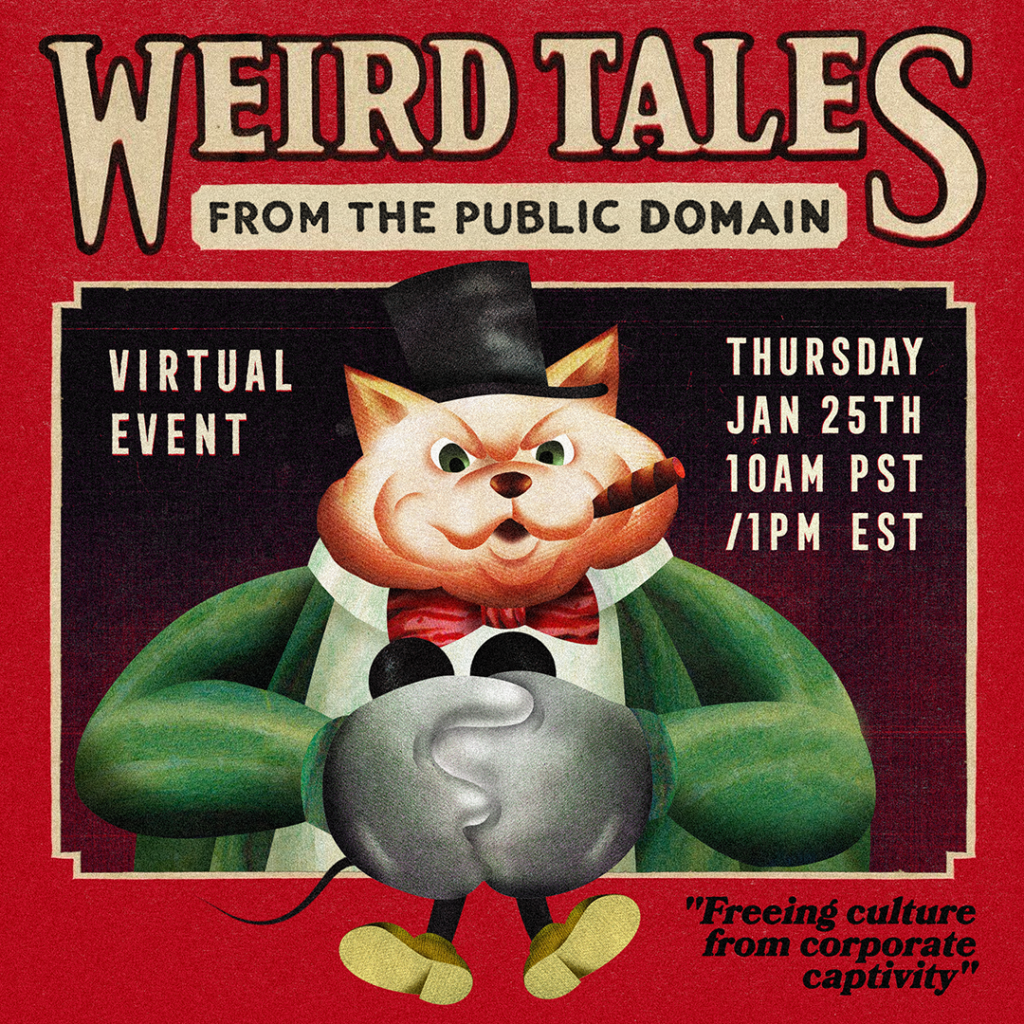
Weird Tales from the Public Domain: Freeing Culture from Corporate Captivity

Register Now!

The mouse that became Mickey will finally be free of his corporate captivity as the copyright term of the 1928 animated Disney film, Steamboat Willie, expires along with that of thousands of other cultural works on the first day of 2024.

The year 1928 brought us a host of still relevant, oft-revived and remixed culture, from H.P. Lovecraft’s classic horror story, “Call of Cthulhu” (originally published in Weird Tales; now currently a popular video game), to the Threepenny Opera, a critique of income inequality and the excesses of capitalism that is surprisingly on point for our current era.

And further, classic works of literature such as Orlando by Virginia Woolfe, Well of Loneliness by Radclyffe Hall, and Black Magic by Paul Mourad; children’s literature like House on Pooh Corner by A. A. Milne, which introduced the character Tigger, and Millions of Cats by Wanda Gág; movies like Charlie Chaplin’s The Circus, and Buster Keaton’s The Cameraman; and music like Dorothy Field’s “I Can’t Give You Anything But Love, Baby” and Cole Porter’s “Let’s Do It, Let’s Fall in Love” will grow the rich set of materials that are freely available to all of us as part of the public domain.  

Join us for a virtual celebration at 10am PT / 1pm ET on January 25, 2024, with an amazing lineup of academics, librarians, musicians, artists and advocates coming together to help illuminate the significance of this new class of works entering the public domain!

Of course our program wouldn’t be complete without a discussion of Generative AI, which to some has become a new kind of Eldritch God unleashed upon humanity—a Chtulhu of sorts—out to alter or control human reality. New AI technologies have raised all kinds of questions about human creativity, and the various monsters we must vanquish in order to preserve it. We’ll get into all that and more in our panel discussion of AI, Creativity and the Public Domain.

REGISTER NOW

This event is co-hosted by Internet Archive, Creative Commons, Authors Alliance, Public Knowledge, Library Futures, SPARC and the Duke Center for the Study of the Public Domain.

More ways to celebrate the public domain!

In addition to our virtual event on January 25th, we are also hosting an in-person party & film screening at the Internet Archive on January 24th for our Public Domain Remix Contest.

Public Domain Day Party in San Francisco! Celebrate 1928

Step into a time capsule of creativity on January 24, 2024, at the Internet Archive, as we celebrate the release of new cultural treasures into the public domain. Join us for an unforgettable evening filled with period tunes, classic cocktails, and a cinematic journey into the past. These works, once bound by copyright restrictions, will be released into the wild, opening up new opportunities for artistic expression, adaptation, and innovation.

REGISTER NOW

Discover the enchantment of animation with a special screening of Steamboat Willie on the large screen. Come together to witness the beloved icon, Mickey Mouse, as he enters the public domain. Let’s rejoice in this moment that commemorates the lasting legacy of a cultural gem that has captivated hearts across generations. Film Historian Eric Smoodin will explore the history of Steamboat Willie and how a mouse changed the entertainment world.

Be captivated by the cinematic brilliance of our annual short film contest winners. These films, inspired by the vast public domain materials on the Internet Archive, showcase the boundless possibilities of reimagining classic works.

Embrace the spirit of 1928 by dressing in your finest flapper dresses, dapper suits, and don’t forget the feathered headbands. You’re not just attending an event; you’re stepping into a world where every outfit tells a story. Be the “Bee’s Knees” and the “Cat’s Pajamas” as you immerse yourself in the glamour of a bygone era.

No celebration from the Jazz Age is complete without a classic cocktail. Let the clink of glasses echo the liberation of creative works now set free in the public domain.

Come share an evening of revelry, inspiration, and artistic freedom with us. Be part of a celebration where the past becomes the canvas for the future. Let the reimagining begin, and together, let’s toast to a world of boundless creativity in the public domain. See you there in your finest attire!

Where: Internet Archive – 300 Funston
When: 6pm to 8 pm
Cost: $15
Register now!

More ways to celebrate the public domain

In addition to our in-person event on January 24th & our film remix contest, we are also hosting a virtual celebration on January 25th, “Weird Tales from the Public Domain: Freeing Culture from Corporate Captivity”—register now!

Join Us for Our Annual Celebration – Thursday, October 12!

We are just one week away from our annual celebration on Thursday, October 12! Party in the streets with us in person or celebrate with us online—however you choose to join in the festivities, be sure to grab your ticket now!

What’s in Store?

📚 Empowering Research: We’ll explore how research libraries like the Internet Archive are considering artificial intelligence in a live presentation, “AI @ IA: Research in the Age of Artificial Intelligence.” Come see how the Internet Archive is using AI to build new capabilities into our library, and how students and scholars all over the world use the Archive’s petabytes of data to inform their own research.

🏆 Internet Archive Hero Award: This year, we’re honored to recognize the incredible Connie Chan, our local District 1 supervisor, with the prestigious Internet Archive Hero Award. Supervisor Chan’s unwavering support for the digital rights of libraries culminated in a unanimously passed resolution at the Board of Supervisors, and we can’t wait to present her with this well-deserved honor live from our majestic Great Room. Join us in applauding her remarkable contributions!

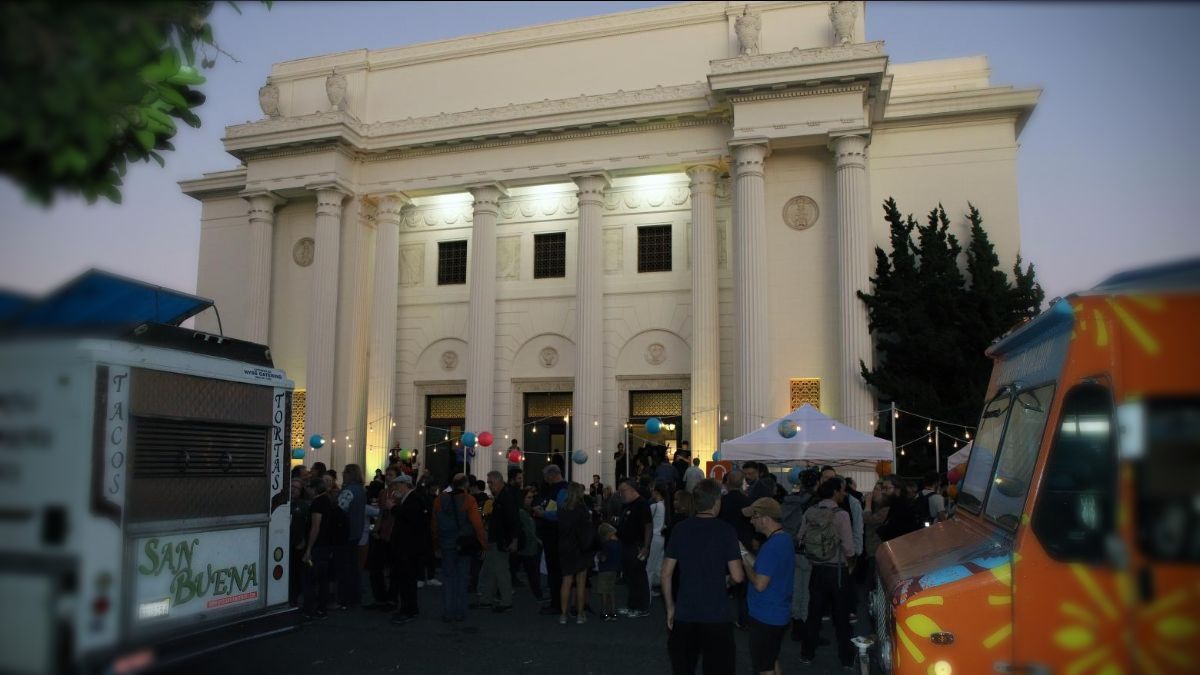
🌮 Food Truck Delights: Arrive early and tantalize your taste buds with an assortment of treats from our gourmet food trucks.

💃 Street Party: After the ceremony, let loose and dance the night away to the tunes of local musicians, Hot Buttered Rum. Get ready to groove and celebrate under the starry San Francisco sky!

🎟️ Register now for in-person or online attendance!

Internet Archive’s Annual Celebration
Thursday, October 12 from 5pm – 10pm PT; program at 7pm PT
300 Funston Avenue, San Francisco
Register now for in-person or online attendance

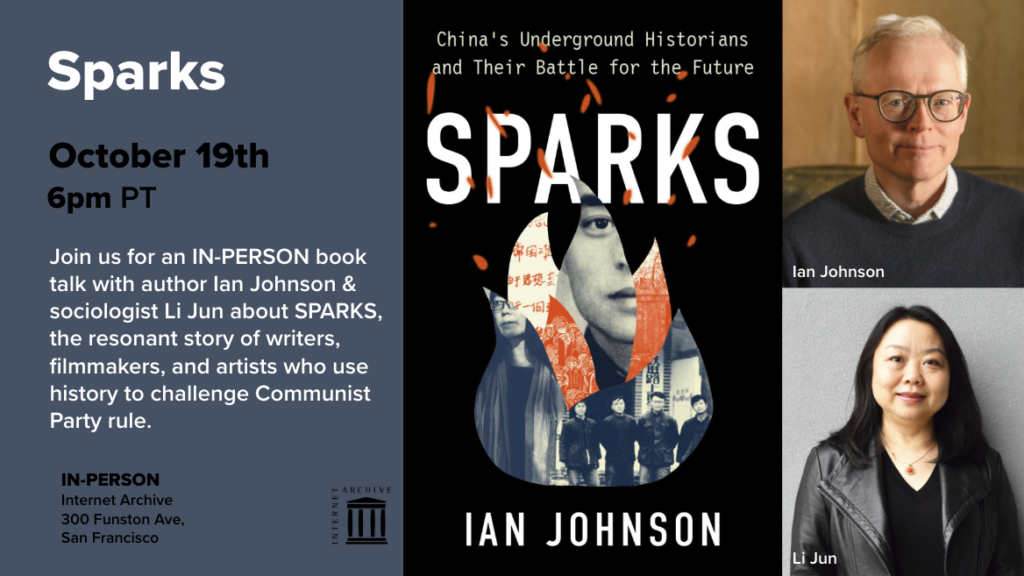
Book Talk: Sparks by Ian Johnson

Join author Ian Johnson and sociologist Li Jun for an IN-PERSON discussion about “Sparks: China’s Underground Historians and their Battle for the Future”

Click Here to Watch the Recording

Sparks tells the resonant story of writers, filmmakers, and artists who use history to challenge Communist Party rule.

6:00 PM — Doors Open
6:30 PM — Book Talk: Sparks by Ian Johnson
7:30 PM — Book Signing

Please note that this event will be held in person at the Internet Archive, 300 Funston Avenue, San Francisco.

Click Here to Watch the Recording

About Sparks
Sparks: China’s Underground Historians and their Battle for the Future (to be published by Oxford University Press on September 26, 2023) describes how some of China’s best-known writers, filmmakers, and artists have overcome crackdowns and censorship to forge a nationwide movement that challenges the Communist Party on its most hallowed ground: its control of history.

The past is a battleground in many countries, but in China it is crucial to political power. In traditional China, dynasties rewrote history to justify their rule by proving that their predecessors were unworthy of holding power. Marxism gave this a modern gloss, describing history as an unstoppable force heading toward Communism’s triumph. The Chinese Communist Party builds on these ideas to whitewash its misdeeds and glorify its rule. Indeed, one of Xi Jinping’s signature policies is the control of history, which he equates with the party’s survival.

But in recent years, a network of independent writers, artists, and filmmakers have begun challenging this state-led disremembering. Using digital technologies to bypass China’s legendary surveillance state, their samizdat journals, guerilla media posts, and underground films document a regular pattern of disasters: from famines and purges of years past to ethnic clashes and virus outbreaks of the present–powerful and inspiring accounts that have underpinned recent protests in China against Xi Jinping’s strongman rule.

Based on years of first-hand research in Xi Jinping’s China, Sparks challenges stereotypes of a China where the state has quashed all free thought, revealing instead a country engaged in one of humanity’s great struggles of memory against forgetting—a battle that will shape the China that emerges in the mid-21st century.

Ian Johnson is a senior fellow at the Council on Foreign Relations. He has lived more than twenty years in China as a student, journalist, and teacher. His work appears regularly in The New York Review of Books, The New York Times, and other publications, and for five years he was on the editorial board of The Journal of Asian Studies. He has won numerous prizes for his coverage of China, including a Pulitzer Prize.

Li Jun (who writes under the penname Li Sipan) is a Ph.D. in political sociology, and a visiting scholar at Stanford University. Before entering academia, she was an investigative reporter for the liberal newspaper group Southern Daily Press and a recognized feminist activist. In 2004, she founded the feminist communications NGO Women’s Awakening Network (新媒体女性), which has played a leading role in China’s anti-sexual harassment campaigns and in the process of legislating against domestic violence. Li’s research focuses on the intergenerational differences in the feminist movement as well as the relationship between the media and the feminist movement in China.

Book Talk: Sparks by Ian Johnson
October 19 @ 6pm PT
IN-PERSON @ 300 Funston Avenue, San Francisco
Register now!

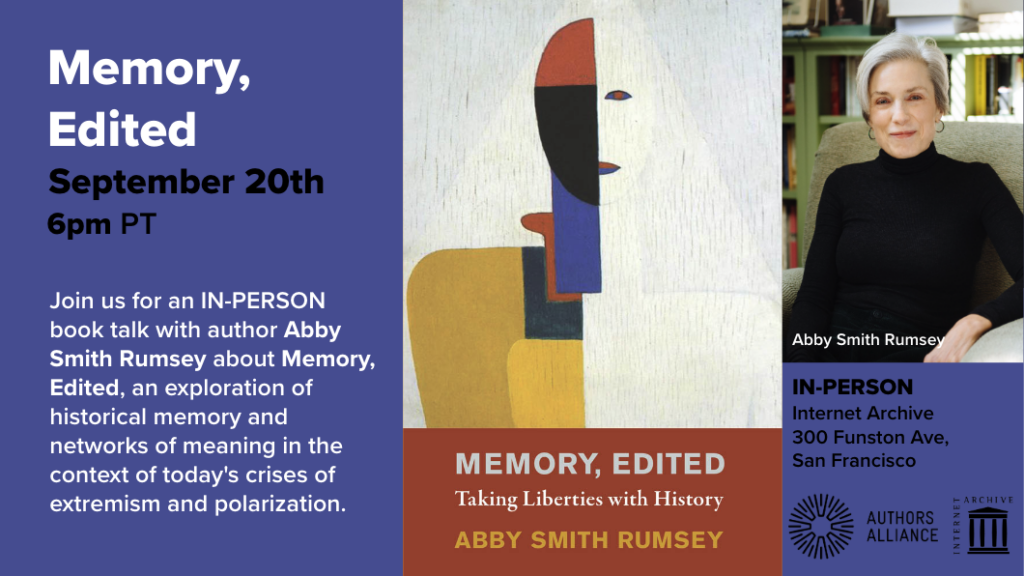
Book Talk: Memory, Edited

Join archivist Rick Prelinger and author Abby Smith Rumsey for an IN-PERSON discussion about “Memory, Edited: Taking Liberties with History.”

REGISTER NOW

An exploration of historical memory and networks of meaning in the context of today’s crises of extremism and polarization.

6:00 PM — Doors Open
6:30 PM — Book Talk: Memory, Edited
7:30 PM — Book Signing

Please note that this event will be held in person at the Internet Archive, 300 Funston Avenue, San Francisco.

REGISTER NOW

About Memory, Edited
As authoritarianism continues to rise around the world, the stories we tell ourselves about what has happened and what is happening become ever more relevant. In Memory, Edited, Abby Smith Rumsey examines collective memory, how it binds us, and how it can be used by bad actors to manipulate us. Bringing forward the voices of a rich cast of Eastern European artists from the past two hundred years—from Fyodor Dostoevsky to Gerhard Richter—Rumsey shows how their work and lives illustrate the devastation wrought by regimes dependent on entrenched lies to survive. This hijacking of the narrative polarizes communities even as it commandeers our future.

Through an interdisciplinary lens that includes the best thinking from history, the arts, cognitive science, psychology, and political philosophy, Rumsey lays bare our narratives, showing how they are constructed and how they have changed over time. Ever-aware of resisting the false promise of utopia, Rumsey argues that only by confronting the past and reckoning with the crimes that were committed can we ever hope to heal and gain self-knowledge. Memory, Edited is an indispensable text for anyone who cares about democracy, equality, and freedom in our current age of crisis.

Abby Smith Rumsey is an intellectual and cultural historian. She chairs the board of the Center for Advanced Study in the Behavioral Sciences at Stanford University and is the author of When We Are No More: How Digital Memory Is Shaping Our Future.

Rick Prelinger is an archivist, filmmaker, writer and educator.

Book Talk: Memory, Edited
September 20 @ 6pm PT
IN-PERSON @ 300 Funston Avenue, SF
Register now!